What Happens During Home Euthanasia
Reviewed by Dr. Robin Teague, DVM (Colorado); Dr. Tracey Decter, DVM (Florida); Dr. Caroline Garrett, DVM, DACLAM (Utah); and Rob Twyning, PEP (Wisconsin) – The Pet Loss at Home Medical Advisory Team

“Rocky”
Passed peacefully in 2022 in the comfort of their own home with the help of Pet Loss at Home.
Key Takeaways:
- In-home euthanasia is a peaceful, two-stage medical process that takes place entirely in your pet’s familiar environment.
- The first stage is a sedative that allows your pet to relax deeply before the final medication.
- The process is painless. Your pet will not experience distress.
- You are present and in control of the pace throughout.
- The veterinarian is there to guide your family, not just your pet.

Many families find that knowing what to expect transforms fear into presence. You don’t have to wonder. You can simply be there.
One of the most common things families say after an in-home euthanasia visit is that it was more peaceful than they expected. The anticipation of the not knowing is often harder than the reality. This page is here to replace uncertainty with clarity. That way, on the day itself, your full attention can be on your pet.
What is in-home pet euthanasia?
In-home pet euthanasia is a veterinary service in which a licensed veterinarian comes to a family’s home to administer euthanasia in a comfortable, familiar environment. The process uses the same medications as clinic-based euthanasia but allows the pet to remain calm and the family to be fully present without the stress of travel or an unfamiliar setting. The medication works by shutting down brain activity first, causing rapid unconsciousness, followed by cessation of breathing and then cardiac activity — a peaceful and painless process.
The In-Home Euthanasia Process: Step by Step
Arrival and Connection
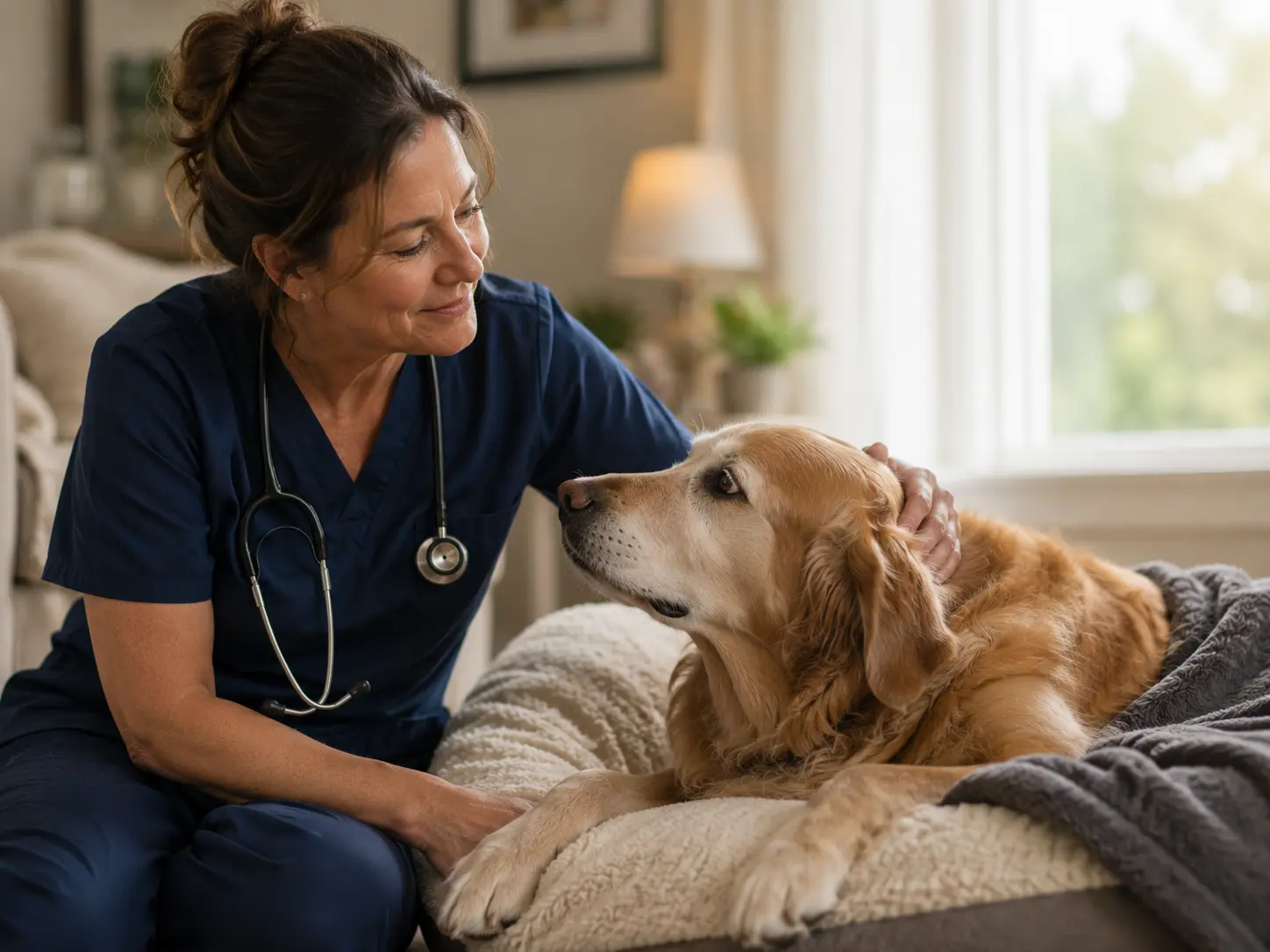
When the veterinarian arrives, they will spend time with your family before any medical steps begin. This is a time to ask any remaining questions, share memories of your pet, and allow your pet to become comfortable with the veterinarian’s presence. There is no rush.
The Sedative
The first medication administered is a sedative. This is typically given as an injection and takes effect within a few minutes. Its purpose is to allow your pet to relax deeply, to release any anxiety, and settle into a state of calm sleep before the final medication is given.
During this stage, you can hold your pet, speak to them, and stay close. Your pet will become drowsy and may lie down naturally. Their breathing will slow and deepen. This stage is gentle and painless.
The Final Medication
Once your pet is fully sedated and at rest, the veterinarian will administer the final medication — an overdose of a barbiturate anesthetic. This medication works by rapidly shutting down brain activity first. Your pet loses all awareness and consciousness within seconds. Breathing then ceases as the brain’s respiratory centers stop functioning. Cardiac activity slows and stops thereafter, though the heart may continue beating for a short time after brain activity has already ceased — your pet is not aware of this process. They will not feel pain. They will not experience distress. They are simply, peacefully, gone.
Confirmation
The veterinarian will check for the absence of a heartbeat using a stethoscope, and will also assess that breathing and brainstem reflexes have ceased. They will gently let you know when your pet has passed. Note that because cardiac activity can sometimes persist briefly after brain activity has already stopped, the veterinarian will take a moment to confirm fully before letting you know.
Time with Your Pet
There is no schedule after the final step. You may take as much time as you need with your pet. Some families sit quietly for a few minutes. Others stay for an hour or more. The veterinarian will remain present to support you and will guide any aftercare arrangements at a pace that feels right for your family.

“The families who are most at peace are the ones who stayed present. Don’t be afraid to be in the room. Your presence is what your pet knows, and it is what matters most.”
Rob Twyning, PEP & Owner — Pet Loss at Home
What You May Observe
It is helpful to know that some physical signs after death are normal and do not indicate distress:
- A deep breath or brief muscle twitch may occur immediately after the final medication. This is a reflex, not a sign of awareness or pain.
- Eyes typically remain open after death. This is normal.
- Bladder or bowel release may occur as the muscles fully relax. Your veterinarian is prepared for this.
- Your pet’s body will feel different to the touch within a short time. They will seem cooler and heavier. This is natural.
Your veterinarian will explain what to expect before it happens, so that nothing takes you by surprise.
Aftercare
After the visit, the veterinarian will assist with your pet’s remains according to the aftercare arrangements you have chosen. Options typically include private cremation, communal cremation, home burial (where regulations permit), and aquamation.
Visit our Pet Aftercare Options page to learn more about each option.
Schedule an In-Home Visit
Call (877) 219-4811 or use the ZIP locator at the top of the page to find a Pet Loss at Home veterinarian in your area.
Frequently Asked Questions
Is in-home euthanasia painful for my pet?
No. The process begins with a sedative that removes all anxiety and discomfort before the final medication is administered. The final medication works by rapidly shutting down brain activity first — your pet loses consciousness and all awareness within seconds. Breathing then stops as the brain’s respiratory centers cease functioning, followed by cardiac activity. Your pet does not experience pain or distress at any point in this process.
Will my pet know what is happening?
Your pet will not understand the medical process, but they will know that they are home, that you are with them, and that they are safe. The sedative ensures that any anxiety is relieved before the final step. Most pets simply relax and fall into a deep sleep.
What if I can’t stay in the room?
That is completely acceptable. You decide what you can handle. Some family members step out and step back in. Some prefer to be in a nearby room. There is no expectation or obligation. The veterinarian will keep you informed and bring you back when you are ready.
How will my pet’s remains be handled afterward?
Your veterinarian will guide this process according to the aftercare arrangements you have selected in advance or at the time of the visit. Remains are handled with care and dignity throughout.

How We Created This Guide
This page was developed in collaboration with licensed veterinarians who specialize in end-of-life pet care. All clinical guidance has been reviewed for medical accuracy. Our editorial process prioritizes compassion, clarity, and evidence-based information to help families navigate one of the hardest decisions they will ever face.